
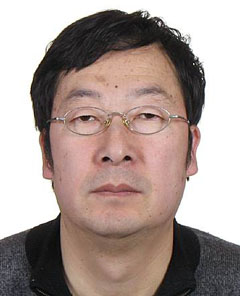
Wanshun Zhang
Doctor,Professor
Research:Quantity and quality evolution and spatial-temporal allocation of water resources
Phone:
Email:wszhang@whu.edu.cn
Prof. Wanshun Zhang is a Ph. D. supervisor and currently works at School of Resources and Environmental Science, Wuhan University. He obtained his D. E. degree at the State Key Laboratory of Hydraulics on High Speed Flows, Sichuan University in 1997. Then he began to work at the postdoctoral research station of civil engineering and water resources, Wuhan University of Hydraulic & Electrical Engineering and cooperated with Academician Jianheng Xie and Prof. Yitian Li.
Since 1986, Prof. Zhang has been committed to the researches on hydraulics, river dynamics, environment management, ecological environmental hydraulics, mathematical simulation and water resources allocation, watershed non-point source pollution, river basin water environment evolution. He has published over 90 academic papers, and 4 monographs. In recent years, he has led or participated in various subjects, and won numerous national, ministerial and provincial-level science and technology awards for his considerable achievements.
Prof. Zhang has achieved outstanding achievements in hydrodynamic numerical computation. He proposed the Free Surface-Pressure-Velocity Coupling Correction Algorithm for the issue of the numerical simulation of 3-D Free Surface Fluid. He also performed the research on the numerical simulation of 2-D Free Surface Fluid, and focused on the Free Surface-Velocity Coupling Correction Algorithm. He has developed a number of mathematical models, including the 1-D, 2-D and 3-D Sediment Mathematical Models, Water Quantity and Quality Coupling Model, Distributed Debris Flow Forecasting Model, Urban Non-point Source Pollution Model, Water Ecology Model and 2-D and 3-D Water Temperature Model. Up to now, he has completed various scientific projects of national, provincial and ministerial, and local levels. The researches on sediment, water temperature, radionuclide (14 kinds), benzene mixtures, debris flow, and many kinds of water quality indices (COD, TP, TN, NH3 and algae), have successfully been use to predict the impacts of major water resources projects on water environment, and provide theoretical basis for the development scheme optimization of the projects. In addition, he has independently supervised over 20 Ph. D. candidates and graduate students.